 Case BC-008 · AI Accountability
The Label Is Doing Less Than the Law Thinks
On 2 January 2026, Communications Psychology published three preregistered experiments from the University of Bristol showing that people who are told a deepfake is fake go on believing what it shows them — and the EU AI Act's flagship answer to deepfakes, written into Article 50, is telling people. The finding is worth sitting with, because nearly every AI transparency law now being drafted, in Brussels and elsewhere, rests on the same untested mechanism: disclose the fake and the fake is defused. This piece is an instance of a pattern BrokenCtrl documents wherever it appears — policy that regulates the paperwork of a harm rather than the harm.
What Bristol Actually Measured
The paper is Clark and Lewandowsky, "The continued influence of AI-generated deepfake videos despite transparency warnings," from the School of Psychological Science at the University of Bristol Verified (Communications Psychology, January 2026). Three preregistered experiments, with 175, 275 and 223 participants. In the first two, participants watched a fabricated video of a fictional local official admitting to taking a bribe; in the third, a deepfake of a vegan influencer confessing to eating meat. Some participants were warned, before or alongside the video, that what they were about to see was fake. The warning conditions were not subtle: one arm received a specific label stating that this exact video was a deepfake.The label did not do its job. Participants who saw the deepfake with a specific warning still rated the official's guilt at +0.87 on the study's scale — on the "probably guilty" side — against −0.40 among controls who never saw the video Verified. In plain terms: people explicitly told "this confession is fabricated" ended up more convinced of guilt than people shown nothing at all. Across all three experiments the warnings reduced the deepfake's influence without coming close to eliminating it. Psychologists have a name for the general phenomenon, the continued influence effect: a retracted claim keeps shaping judgment after the retraction is accepted. What Bristol adds is the first preregistered evidence that the effect survives the exact intervention lawmakers have chosen as the remedy.
A warned viewer is a persuaded viewer with a footnote.
The Assumption Written Into Article 50
Article 50 of the EU AI Act is the transparency article Verified (Regulation (EU) 2024/1689). Providers of systems that generate synthetic content must mark outputs in a machine-readable format, detectable as artificially generated (Art. 50(2)). Deployers of deepfakes "shall disclose that the content has been artificially generated or manipulated" (Art. 50(4)). The disclosure must reach "the natural persons concerned in a clear and distinguishable manner" at first exposure (Art. 50(5)). The structure of the article reveals the theory of harm it holds: the duty runs to the viewer, the protection is the viewer's knowledge, and once the viewer knows, the regulation's work is done. Obligations end where the label begins. The strongest defence of Article 50 deserves stating properly. Labelling was never claimed to be a complete remedy; it serves consent and provenance, it gives platforms a machine-readable hook for downstream moderation, and a label that reduces influence is still better than no label. All of that is fair, and none of it is the problem. The problem is where the article stops. Article 50 imposes no duty beyond disclosure — no takedown, no friction, no remedy for the person defamed by a labelled fake — because the drafting assumes disclosure is where the harm ends. The Bristol data says the harm walks through the disclosure.A fully compliant deepfake is a working defamation machine with a compliance sticker on it. Credit where due on the sourcing trail: the study surfaced through the newsletter The Slow AI ("Epistemic Crisis," August 2026) Probable, cited here only as the pointer. The newsletter, arguing our side of the question, claimed the Bristol experiments found labels "halve the damage." The paper says no such thing, and what it does say is worse: the influence substantially survives, and in the guilt-judgment data a majority of warned viewers convicted anyway. Even the critics of labelling are overestimating the label.
The Majority That Believed the Label and the Video Both
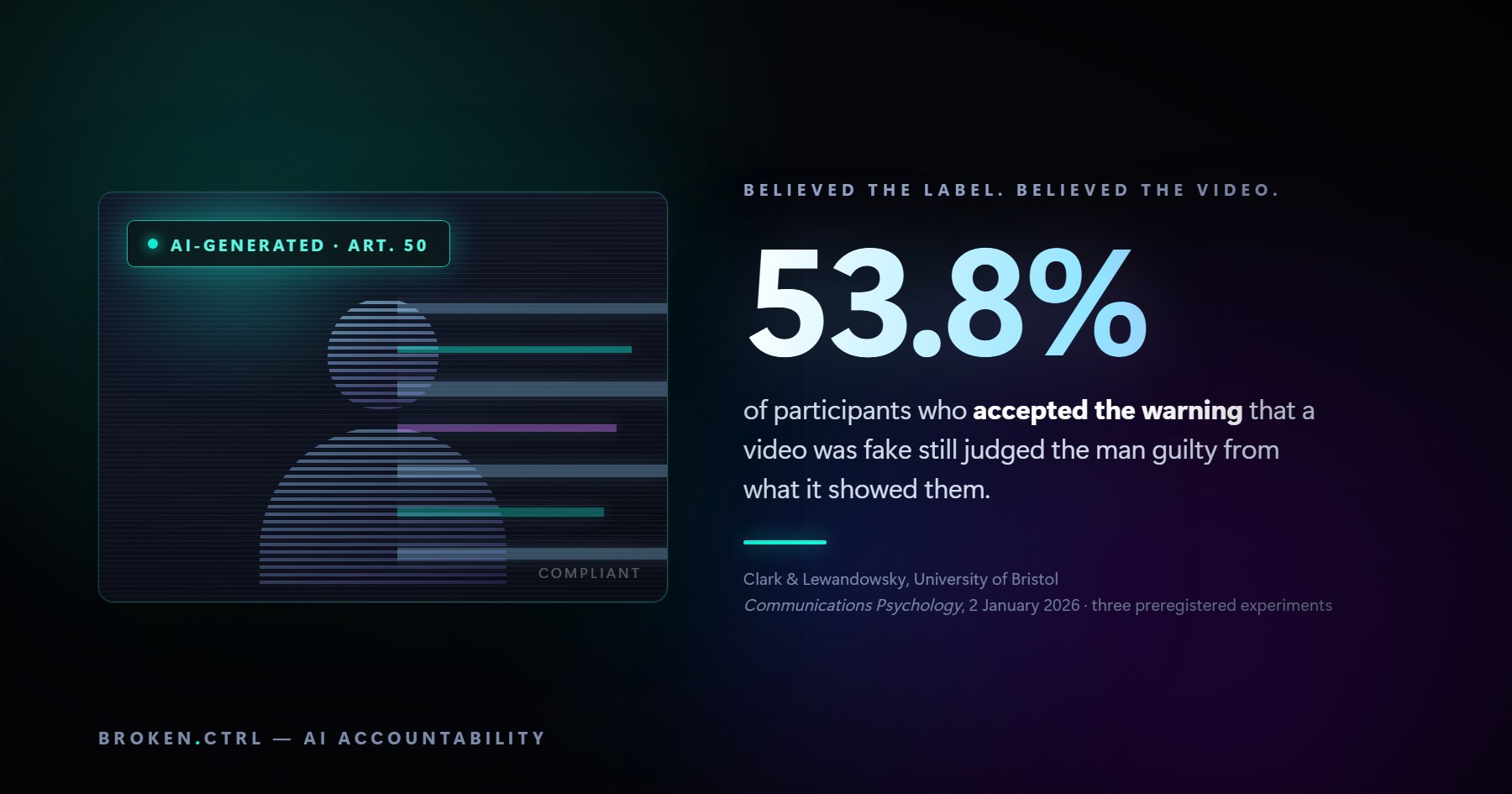
The numbers that matter most sit in the paper's qualitative follow-up Verified. Asked how they reached their guilt judgments, 53.3 per cent of participants in the specific-warning condition said they judged the official from the content of the video — the video they had just been told was fabricated. The study then isolated the 52 participants who explicitly accepted the warning, the ones who said yes, I understand this video is fake. Of those, 53.8 per cent still drew their conclusion about the man's guilt from what the fake showed them. That is the finding Article 50 cannot survive intact: the failure is not among viewers who missed the label or refused to believe it. The label was delivered, received and believed, and a majority of exactly those viewers convicted the man on the strength of a confession that never happened.Disclosure worked. Protection did not follow. Placed side by side, the two documents complete the contradiction. The regulation's transparency chapter discharges the deployer's duty at the moment of disclosure, on the assumption that an informed viewer is a defended viewer. The only preregistered experiments yet published on that assumption find that the informed viewer — informed precisely as Art. 50(5) prescribes — believes the fabrication anyway, most of the time. This is not an argument that Article 50 should be repealed, and the aggregation of evidence here is one paper, three experiments, one class of harm; the verdict extends no further than that. But a legislature that mandates a safety mechanism owes the public some evidence the mechanism works, and on deepfake labelling the evidence runs the other way.
The labelling duty is documented, the label's failure is documented, and the law has not noticed they contradict each other.
Continue reading
The gap between what a policy says and what it enforces is the subject of AI Ethics Enforcement: Policy vs Reality. The same gap in a US instrument is documented in Voluntary AI Regulation: Trump's 2026 AI Executive Order. Where a foreseeable harm meets a control that does not stop it, the framework is Foreseeable Misuse as Negligence.Questions
Does labelling a deepfake stop it working?
Not according to the only preregistered evidence available. In three experiments at the University of Bristol, participants given a specific warning that a video was fake still rated the depicted man's guilt at +0.87, against −0.40 among people never shown the video.
What does Article 50 of the EU AI Act require?
Providers must mark AI-generated content in a machine-readable format (Art. 50(2)); deployers of deepfakes must disclose that the content has been artificially generated or manipulated (Art. 50(4)); and the disclosure must be clear and distinguishable at first exposure (Art. 50(5)). The article imposes no duty beyond disclosure.
How many people believed the deepfake despite the warning?
53.3 per cent of participants in the specific-warning condition judged the official from the video's content. Among the 52 participants who explicitly accepted the warning, 53.8 per cent still drew their conclusion from what the fake showed them.
Is this an argument for repealing Article 50?
No. The evidence here is one paper, three experiments and one class of harm. What it establishes is that the mechanism the article relies on has not been shown to work, and that the only preregistered test of it points the other way.
What is the continued influence effect?
The documented tendency of a retracted or corrected claim to keep shaping judgment after the correction has been received and accepted. The Bristol experiments are the first preregistered evidence that it survives deepfake labelling specifically.
Sources
Clark, S. & Lewandowsky, S. — "The continued influence of AI-generated deepfake videos despite transparency warnings," Communications Psychology, January 2026 — Verified, read directly
Regulation (EU) 2024/1689 (EU AI Act), Article 50(2), 50(4), 50(5) — Verified, text of the regulation
The Slow AI — "Epistemic Crisis," August 2026 — Probable, pointer only; its "halve the damage" characterisation is corrected above
Last updated: 30 August 2026 · Status: Active